What
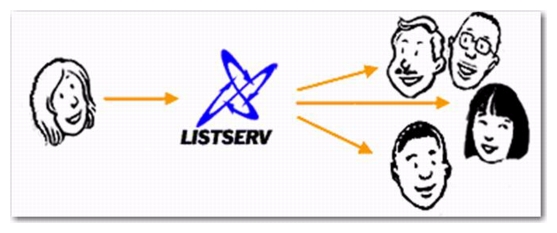
This page provides a brief explanation of listservs. A list service provides groups safer and more-convenient email by hiding the distribution. It does this by limiting who can email to the group, and by adding a layer of spam protection.
Why
It may seem natural to place the entire group on the “to:” line of an email. This is very common. But this practice increases the chance that recipients will eventually start receiving very convincing spam emails. Once the distribution is known by anyone with illegitimate motives, that person can send an email that appears to come from one of the recipients, spoofing the “From:” and “Reply to:” fields. Replying to that email, or following a link contained in that email, leads to further trouble. A mailing list like this avoids most of these troubles.
What
A listserv sets up a new email address which forwards all incoming email to the group. It does not forward emails that are spoofed in any way (looks like it comes from someone when it doesn’t), and it does not forward emails from anyone outside the group. Using a listserv does not expose all recipients with every email (like placing everyone on the “bcc:” line). If the email address of anyone in the groups is hacked, so that spam really is coming from that address, that address can be removed from the group to prevent further annoyance and danger. The listserv is not foolproof, but it helps.
Why
Using a service, such as Google Groups, provides that layer of protection for anyone on the list. It is safer than using a broad distribution list on your emails. It is also the only way to email over 100 people and it supports a conversation so others can see the questions. This is why a listserv is helpful.
Our Google Group, gathering-26@googlegroups.com
If you are on the list, you will receive group emails from the address:
gathering-26@googlegroups.com
You can also send emails to that address in order to contact the whole group. If you register for the group by using a Gmail address, you can go to the site,
https://groups.google.com/d/forum/gathering-26
to review older discussions and view membership in the group.
You do not need a Gmail account to use this service. Here is more on why, if you’re interested. While listservs have been around since the beginning of the internet, Google had a way to leverage their successful search engine to enhance that technology. This is the kind of thing all successful internet-based firms have done: offer a valuable service and, when it becomes essential and popular, leverage it to make money. A more-detailed discussion describes the life cycle of internet platforms. We can see google leveraging this service to enhance their dominance in email by awarding group members who use a Gmail address with access to additional features. We will counter this by providing that information to the other members, so there is no advantage here to having a Gmail account.
Conclusion
Take an informed approach to limiting your risks. Understand the basics and, if you are joining a group and have any question, ask the group owner.
— your humble group owner, Mike Treanor